B2B Privacy Firewalls & Cookieless Tracking: The Complete 2026 Guide
60% of browsers now block Third-Party Cookies. Enterprise organizations lose massive data volumes as a result. This guide shows how Server-to-Server tracking, Edge firewalls, and structured data solve the problem completely.

Why Third-Party Cookies Have Failed Enterprise B2B
The philosophy that powered privacy-focused search engines like DuckDuckGo — the systematic blocking of invasive third-party tracking — reflects a fundamental shift in how digital privacy is understood. In the B2B sector, this shift has concrete technical consequences that extend far beyond symbolic cookie banners.
Third-Party Cookies — the small text files that an external service (Google, Meta, LinkedIn) stores in the browser across different websites — have been under massive pressure since 2020. Safari has blocked them entirely since ITP 2.3. Firefox introduced Enhanced Tracking Protection. Chrome has committed to the Privacy Sandbox as a standard by 2025. For B2B organizations, this means: up to 60% of website visitors are invisible when relying exclusively on client-side pixels.
The problem is compounded by the working environment of your target audience. A procurement director at a Fortune 500 company doesn't use a personal browser. They work within intranets with strict proxy rules, active content filters, and pre-installed ad blockers. This infrastructure renders classic frontend pixels useless — not as a side effect, but by design.
The Technical Anatomy of the Problem
To understand why server-side tracking is superior, you need to understand the classic architecture. A typical Facebook Pixel works like this:
- The user's browser loads the page
- A JavaScript snippet is fetched from Facebook's CDN (~80KB)
- The script sets a Third-Party Cookie and sends an HTTP request to Facebook's servers
- Facebook matches the request to a user profile
This model has four fundamental weaknesses in the B2B world:
Latency: Every external script delays load time. Google measures through Core Web Vitals how quickly a page becomes interactive (Time to Interactive / TTI). A single marketing pixel can add 200–400ms of latency. With five pixels (Google Analytics, Facebook, LinkedIn Insight, HubSpot, Hotjar), that adds up to over a second. For Web Development in the enterprise space, this is unacceptable.
Security: Every external script is a potential attack surface. Supply-chain attacks like the Polyfill.io incident in 2024 demonstrated that even trusted CDN scripts can be compromised. In B2B contexts where sensitive pricing negotiations or NDA-protected product data are accessible on the website, this represents a significant risk.
Compliance: GDPR requires informed consent before setting cookies. In B2B contexts, cookie banners typically yield consent rates of only 30–40%. The remaining 60–70% of visitors become completely invisible — precisely the C-Level decision-makers who routinely click "Reject All."
Accuracy: Browser-based tracking suffers from session fragmentation. When a user visits your site on their laptop, then sends a colleague an email, who then registers on their smartphone, that counts as two completely separate journeys. The conversion gets attributed to the wrong touchpoint — or not captured at all.
1. Server-to-Server (S2S) Tracking: How It Actually Works
Server-to-Server tracking (also called Server-Side tracking or CAPI — Conversion API) moves data collection entirely from the browser to the server. The technical flow:
- The user interacts with your Next.js application (e.g., submits a contact request)
- The Vercel Edge Server registers the event server-side — no JavaScript in the browser
- Your backend formats the data according to the respective API specification (Meta CAPI, Google Measurement Protocol, LinkedIn CAPI)
- The server sends the data directly via an authenticated HTTPS connection to the platform
The critical difference: The user's browser is not involved at any step. Ad-blockers? Irrelevant. ITP restrictions? Don't apply. Cookie banner? Not needed for these data points, since no cookie is set.
Concrete Implementation with Next.js and Vercel
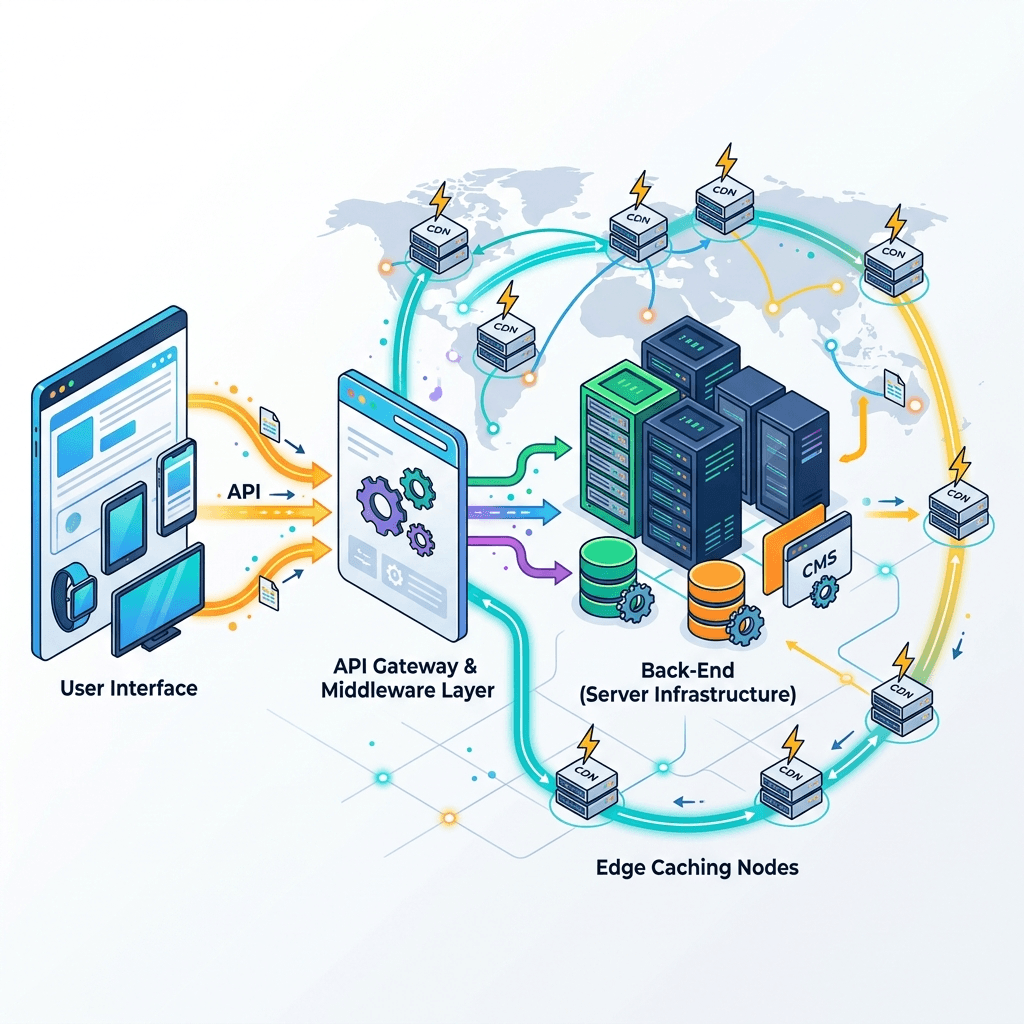
In our architecture, we use Next.js API Routes or Vercel Edge Functions as a middleware layer. When a user submits a form:
- The Next.js API Route processes the request server-side
- Simultaneously, a dedicated API call is sent to Meta's Conversion API, including a hashed email (SHA-256) and event metadata
- Google receives the data via Measurement Protocol v2
- All calls are authenticated via server-side tokens — no publicly exposed API keys
The advantages in hard numbers:
- Data capture rate: 95%+ instead of 35–40% with classic pixels
- Load time reduction: 400–800ms less TTFB through elimination of external scripts
- Core Web Vitals: Consistent "Good" scores (LCP < 2.5s, CLS < 0.1, INP < 200ms)
2. Zero-Trust Privacy Firewall: Defense at the Edge
The classic security model (Perimeter Security) assumes that traffic behind the firewall is trustworthy. In a world of distributed microservices, API gateways, and edge computing, this assumption is dangerously outdated.
Zero-Trust Architecture operates on a simple but radical principle: No request is trustworthy until proven otherwise. In our implementation this means:
Edge-Based Validation: Vercel Middleware examines every incoming request at the edge — geographically as close to the user as possible. Rate limiting, bot detection, and IP reputation checks happen in under 10ms, before the request even reaches the origin server.
DMARC/SPF/DKIM for Emails: In B2B, email is the primary communication channel. We configure strict DMARC policies (p=reject) that prevent phishing emails from being sent under your domain. This not only protects your customers but significantly improves email deliverability with enterprise mail servers.
Content Security Policy (CSP): Restrictive HTTP headers define exactly which domains may load scripts or resources. Since we don't use Third-Party pixels, the CSP can be configured extremely restrictively — practically a whitelist of just two entries (your domain and Vercel's CDN).
Subresource Integrity (SRI): All included scripts are tagged with cryptographic hashes. Even if a CDN is compromised, manipulated files cannot be loaded.
3. The Enterprise Procurement: Measuring Leads That No Cookie Can See
The Enterprise Procurement describes all touchpoints that classic tracking cannot capture: forwarded emails between colleagues, screenshots in Slack channels, verbal recommendations, research through AI assistants like ChatGPT or Perplexity. In B2B, Gartner estimates that up to 70% of the buyer journey falls into this invisible area.
Structured Data as an Alternative to Invasive Tracking
Our Digital Consulting strategy relies on structured data rather than invasive tracking. Instead of marking the visitor, we define your platform as undeniable authority:
- JSON-LD Schema.org Markup: We implement
Organization,Service,FAQPage, andArticleschemas on every page. This machine-readable data is preferentially processed by Google, Bing, and AI systems. - Entity Graphs: By linking Author, Organization, and Service entities, we build a Knowledge Graph that confers algorithmic authority on your brand.
- E-E-A-T Signals: Experience, Expertise, Authoritativeness, and Trust are encoded through verifiable author profiles, publication dates, and expert citations — not through cookies.
When a C-Level decision-maker researches your company in the Enterprise Procurement — for example, by asking ChatGPT about "Enterprise web agency headless Next.js" — the AI system references your structured entity graph. Brand perception is controlled through data, not through invasive trackers.
4. Measurable Results: Concrete KPIs After Migration
We measure the success of an S2S migration not subjectively, but through hard KPIs:
| Metric | Before (Pixel-Based) | After (S2S) |
|---|---|---|
| Event Capture Rate | 35–45% | 92–98% |
| TTFB (Time to First Byte) | 800–1200ms | 80–200ms |
| CLS (Cumulative Layout Shift) | 0.15–0.3 | < 0.05 |
| Cookie Consent Dependency | 100% | 0% (for S2S events) |
| XSS Attack Surface | High (5+ external scripts) | Zero |
These figures come from real migration projects. The improvement in data accuracy alone typically amortizes the investment within 3–4 months.
Conclusion: Cookieless Is Not a Sacrifice — It's an Upgrade
The "Cookieless" era is not a threat, but a technical upgrade for organizations willing to modernize their tracking infrastructure. Anyone still trying to force B2B conversions using outdated Third-Party pixels loses both data quality and compliance security.
MyQuests implements a three-stage approach for Enterprise clients:
- Audit and Purge: Identification and removal of all Third-Party scripts
- S2S Architecture: Implementation of server-side tracking via Next.js API Routes
- Edge Hardening: Zero-Trust firewall, CSP headers, DMARC configuration
The result: More precise data, faster load times, full GDPR compliance — and an architecture that still works in five years because it doesn't depend on browser vendors.




![Platform Economics 2026: The Algorithmic Cadence of Monetization [Case Study]](/insights/images/hero-social-media.png)

![DuckDuckGo and the Privacy-First Infrastructure: Why B2B Organizations Must Architect for Zero-Tracking [2026]](/insights/images/hero-digital-success.png)